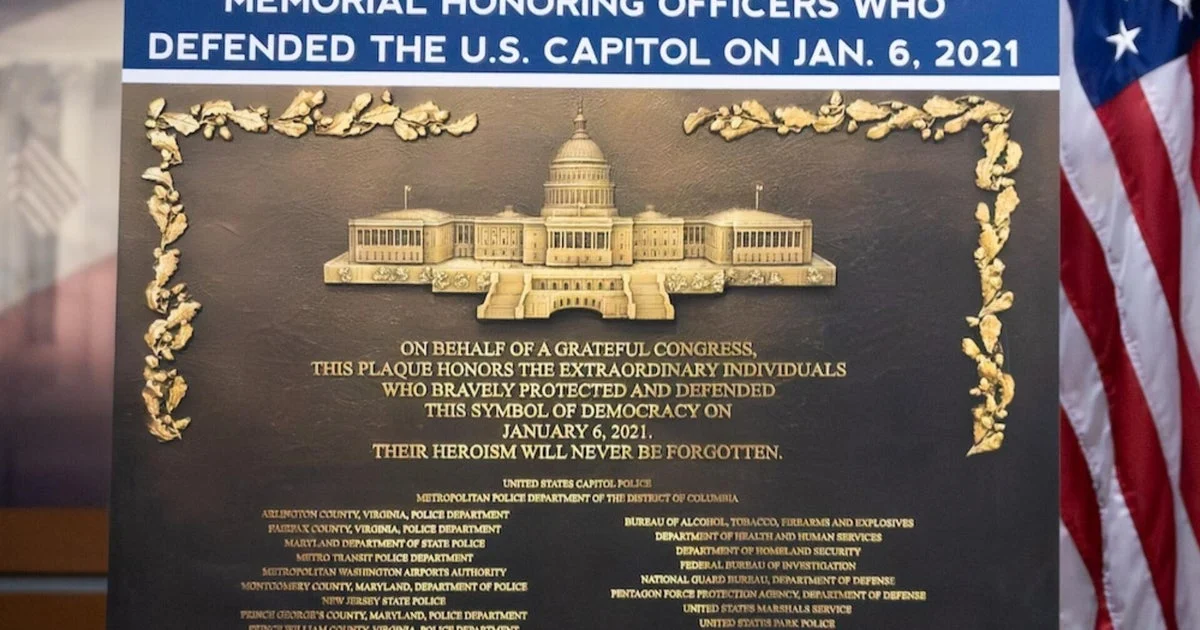
West Wood blvd – 21 May 2026 | In a dramatic escalation of legal battles stemming from the Capitol breach, Jan. 6 police officers sue DOJ [titlebase] as two veteran law‑enforcement officers seek to halt a newly created $1.8 billion anti‑weaponization fund that they say rewards the very rioters who attacked the U.S. Capitol on January 6, 2021.
Harry Dunn, a former Capitol Police officer, and Daniel Hodges, a Metropolitan Police Department officer, filed the lawsuit in the U.S. District Court for the District of Columbia on May 20, 2026. Their complaint argues that the fund, established by Acting Attorney General Todd Blanche and Treasury Secretary Scott Bessent, violates the Constitution’s 14th Amendment, which bars the government from paying debts incurred in aid of insurrection, and contravenes the Administrative Procedure Act by bypassing required rule‑making procedures.
![Trump threatens Boebert [titlebase]: GOP Rift Deepens as President Targets Colorado Rep Over Massie Alliance](https://westwoodblvd.com/wp-content/uploads/2026/05/trump-threatens-boebert-titlebase-gop-rift-deepens-as-president-targets-colorado-rep-over-massie-alliance-300x169.webp)
The plaintiffs contend that the anti‑weaponization fund, formally described as a $1.8 billion pool for individuals who claim they were unfairly targeted by prior administrations, will inevitably funnel money to participants in the Jan. 6 attack and to paramilitary groups such as the Proud Boys. They warn that the fund sends a chilling message that violent actions carried out in the name of former President Donald Trump will not only escape punishment but also be compensated with taxpayer dollars.
According to the complaint, the fund’s creation was tied to a settlement in a separate $10 billion lawsuit that Trump and his family filed against the Internal Revenue Service over the leak of his tax returns. The settlement allowed the Trump family to drop the suit in exchange for the establishment of the anti‑weaponization fund, which now stands ready to disburse payments to applicants who assert they were victimized by the government.
Legal experts note that the lawsuit raises complex questions about the separation of powers and the limits of executive authority. “If the fund is used to compensate individuals who participated in an insurrection, it could be seen as a direct violation of the Constitution,” said constitutional scholar Dr. Elena Morales of Georgetown University. “Moreover, the process by which the fund was created appears to sidestep the usual administrative rule‑making safeguards, potentially opening the door for further challenges.
The Department of Justice, in a statement, defended the fund as a legitimate effort to address perceived political persecution. “The anti‑weaponization fund is designed to provide relief to those who have been unjustly investigated or prosecuted,” the DOJ said. However, the agency also emphasized that applications would be rigorously reviewed and that the fund does not guarantee payment to anyone simply because they were present at the Capitol on Jan. 6.
Critics argue that the fund’s very existence legitimizes extremist behavior. “By creating a slush fund for insurrectionists, the administration is effectively rewarding anti‑democratic actions,” said former U.S. Senator Mark Reed, a vocal opponent of the Trump administration’s policies. “This sets a dangerous precedent that could embolden future attempts to undermine the rule of law.
In response to the lawsuit, Acting Attorney General Blanche asserted that the fund is a lawful exercise of executive discretion and that any claims of constitutional violation will be addressed in court. “We are confident that the anti‑weaponization fund complies with all applicable statutes and constitutional provisions,” Blanche said.
The case also highlights the ongoing tension between the federal government and law‑enforcement officers who defended the Capitol. Both Dunn and Hodges have reported receiving threats and harassment since the events of Jan. 6, and they argue that the fund poses a direct threat to their safety by potentially empowering those who targeted them.
Legal analysts predict that the court’s decision could have far‑reaching implications for how the government compensates individuals in politically charged contexts. If the judges rule in favor of the plaintiffs, the anti‑weaponization fund could be dismantled or significantly restructured, setting a precedent for future challenges to executive‑branch financial initiatives tied to political disputes.
Regardless of the outcome, the lawsuit underscores the deep divisions within the United States over accountability for the Capitol attack and the role of the federal government in addressing perceived grievances. As the case proceeds, both sides are preparing for a protracted legal battle that may ultimately reach the Supreme Court.
In the meantime, Jan. 6 police officers sue DOJ [titlebase] continue to advocate for the protection of law‑enforcement officers and the preservation of democratic institutions, urging the courts to intervene before the anti‑weaponization fund can be used to fund extremist activities.