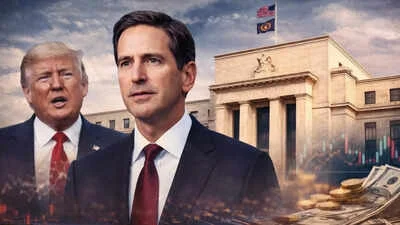
West Wood blvd – 19 May 2026 | In a ceremony that will be To be sworn in as Fed chair [titlebase], President Donald Trump is slated to usher Kevin Warsh into the helm of the United States central bank this Friday. The event marks the first time in nearly four decades that a Federal Reserve chair is sworn in at the White House, a tradition last observed when Alan Greenspan took office in 1987.
Warsh, confirmed by a razor‑thin 54‑45 Senate vote, steps into a role fraught with challenges. The U.S. economy is grappling with persistent inflationary pressures exacerbated by the ongoing conflict between Israel and Iran, which has disrupted oil supplies and pushed energy prices higher. At the same time, the labor market remains resilient, leaving policymakers uncertain about the timing and direction of interest‑rate adjustments.
Analysts note that Warsh inherits a Federal Open Market Committee (FOMC) that is cautious about cutting rates. Antonio Gabriel, a global economist at Bank of America Securities, remarked, “Warsh inherits a committee with little appetite to cut.” The prevailing sentiment among economists is that any rate move—whether a hike or a cut—will likely be delayed until at least next year, as they assess the impact of geopolitical risks on inflation and growth.
Beyond the economic landscape, Warsh’s appointment raises questions about the independence of the Fed from the White House. Critics argue that his close ties to the Trump administration could compromise the central bank’s autonomy, especially as President Trump has signaled a desire for markedly lower interest rates—a stance that appears increasingly untenable given the current macro‑economic headwinds.
The timing of the swearing‑in ceremony is also notable. Just days before the event, President Trump announced a postponement of a planned military strike on Iran after appeals from Saudi Arabia, the United Arab Emirates, and Qatar. The decision temporarily eased oil‑price volatility, with Brent crude dropping more than 2% to around $109 per barrel. However, analysts warn that the Strait of Hormuz remains a chokepoint, and any future disruptions could reignite supply concerns, further complicating the Fed’s policy calculus.
Warsh’s background includes a decade of experience on the Fed’s Board of Governors, where he was known for advocating a more dovish stance on monetary policy. Yet, his recent confirmation battle highlighted deep partisan divides, with many Senate Democrats expressing skepticism about his willingness to shield the Fed from political pressure.
As the nation watches the historic ceremony, market participants are bracing for the signal Warsh’s leadership will send. Bond markets have already reacted to the broader uncertainty, with the 10‑year U.S. Treasury yield climbing to its highest level in a year. The interplay between fiscal policy, geopolitical tensions, and the Fed’s future direction will be closely monitored by investors worldwide.
Warsh’s first day will likely involve extensive briefings on the current state of the economy, a review of the Fed’s balance sheet, and meetings with senior staff to outline his strategic priorities. Observers anticipate that he will emphasize data‑driven decision‑making while navigating the political expectations of a president eager for rate relief.
In summary, the upcoming event To be sworn in as Fed chair [titlebase] not only symbolizes a rare White House tradition but also underscores the pivotal moment at which monetary policy, global geopolitics, and domestic politics intersect. The world will be watching how Warsh balances these forces and whether his tenure will steer the U.S. economy toward stability or further turbulence.
The ceremony will conclude with Warsh delivering remarks that are expected to reassure markets of the Fed’s commitment to its dual mandate of price stability and maximum employment, even as the nation navigates an uncertain global environment. This historic moment To be sworn in as Fed chair [titlebase] will be a litmus test for the independence of America’s central bank in the years ahead.